Sunday, 2 October 2016

'Luke Cage' review

Sweet Christmas!

Luke Cage is the latest series developed via the so far successful partnership with Marvel and Netflix, following two seasons of Daredevil and one series of Jessica Jones. The show is obviously based upon the Marvel Comics character of the same name, portrayed by Mike Colter, who made his debut as the bulletproof hero in 2015's Jessica Jones. Now, the spotlight is shining on Luke with suitably high expectations from the strong quality of Marvel and Netflix's previous collaborations, plus the strong responsibility of Luke Cage being Marvel's most diverse project to date.

This review is spoiler-free!

Mike Colter as the indestructible Luke Cage is a fantastic lead.
The good thing with Luke Cage, and the only thing we really knew for sure going in, is that Mike Colter makes for a fantastic Cage. I, personally, thought he was one of the standout stars of last year's Jessica Jones, behind only David Tennant's performance as the chilling antagonist. So going into Cage's solo project, I was confident the show would at least have a strong lead, and Colter doesn't let us down. One of the things I really appreciated about Colter's performance was the range he captured within Cage. It'd be too easy for the character to be a one-note and rather stereotypical tough guy who doesn't open up and is bitter due to being raised in a tough neighbourhood. However, Cage is actually more interesting than that in my opinion, with him actually seeming like one of the nicest guys in the Marvel Cinematic Universe, as long as you don't piss him off or hurt those around him. Mike Colter really managed to sell me on the fact that Luke Cage is definitely a guy you'd love to hang out with and grab a beer with, but you'd be shitting your pants if you got on his bad side, which isn't exactly an easy balance to strike. Of course, as important as a lead actor is, the show can all too easily crumble if those around him aren't up to standards either, and thankfully this isn't a problem facing Luke Cage.

Mahershala Ali as Cornell Stokes / Cottonmouth is a strong foe for Cage.
Rosario Dawson returns in her role as Claire Temple from both Daredevil and Jessica Jones, and she's better than she has ever been here. Within the context of the comics, Claire has always been primarily affiliated with Luke Cage, so it's perhaps fitting that here is where she gets the beefiest role and the best chance to develop both her character and her performance. Luke Cage certainly helps cement her role as one of the most fascinating recurring characters within the MCU. Marvel and Netflix having a game-plan of their various projects allows them to introduce characters like Claire before they meet the character they are most affiliated with, and Luke Cage is no exception, as it introduces us to Misty Knight, a frequent Iron Fist character, portrayed by Simone Missick. Missick's performance is another of the show's strongest, and it's not hard to imagine that her character will quickly become a fan-favourite on the Netflix shows. Netflix is also known for introducing some of the MCU's greatest villains to us, such as Wilson Fisk and Kilgrave, and Mahershala Ali gives us our latest Netflix villain in the form of Cornell Strokes, also known as Cottonmouth, who was one of my favourite actors on the show. He provided an interesting antagonist to face off against Cage with interesting motivations as we come to expect from the show, and there was something fresh about Cottonmouth that helped him avoid becoming too similar to other crime bosses such as Wilson Fisk. Perhaps it was his respect for Harlem that mirrored Cage's own. Alfre Woodard also stars as Mariah Dillard, who was equally phenomenal. You might recognise Woodard from meeting another superhero earlier this year, when she confronted Iron Man in Captain America: Civil War about collateral damage from his heroics. However, as cool as it might be to finally see the TV universe have an effect on the films, her character within Luke Cage is completely separate, and the casting in both is purely coincidental. Nevertheless, Luke Cage probably holds the best cast of any Marvel TV project thus far, and the show really succeeds because of it.


Luke Cage's narrative is mostly strong, but stumbles late in the season.
While I'm going to avoid specific elements of the plot in this review due to spoilers, it's fair to say that the bare-bones premise of the show is Luke Cage doing heroics and battling evil forces within Harlem, such as Ali's Cottonmouth. The show, obviously, becomes much more detailed and intricate than that, but I won't spoil any of the inner workings. The story was actually really interesting, and seeing Luke evolve into the character we know from the comics is just as fun as it was with Matt Murdock in Daredevil. Like the previous two shows, Luke Cage uses it's thirteen-episode order to also give us more details into the villains' stories, and that also did not disappoint. However, I've got to make note of something that bugged me with Jessica Jones, Daredevil Season Two and now Luke Cage. All three seasons seemed to have a dipping point in quality, around about two-thirds or three-quarters into the show (I think I noticed it at about episode 8 for Cage). At about the same point in all three seasons, I couldn't help shake the feeling that something was happening on-screen just because Netflix wanted 13 episodes, and that the show might be better off with just 10 episodes for a tighter narrative. Maybe it's just me, but with this being the third season of Marvel / Netflix TV in a row to give me the same effect I can't help but wonder if Netflix should make their episode order more flexible to the creators. Luke Cage manages to get back on track for the finale, but it feels like the season's peak is about 5 or 6 episodes in. One of the strongest episodes was one of the last, and I certainly wasn't disappointed in the resolution, but once you lose track and throw off pacing, it's hard to build back the same momentum, and Cage fell just short of getting it back for me. Perhaps one of the root causes of the loss of momentum is that it feels a little bit like around this time the show transitions from one story to another, and it doesn't do it quite as elegantly as it should have.

The show's dedication to developing a rich culture is one of the highlights.
Nevertheless, Luke Cage never becomes a bad show, or even a mediocre one. It just feels that it takes a brief step down from great to good. The show always offers plenty to enjoy, even in those few "off" episodes. The show's connection to black culture is one of its strongest assets, and one that seperates Luke Cage not only from its sister shows like Daredevil, but from all shows within the superhero genre such as The Flash and Gotham. Hot on the heels of a video that went viral criticising Marvel's use of generic and almost lazy music to score their films, Luke Cage brings one of the greatest examples of superhero soundtracks since Marvel's own Guardians of the Galaxy with Star-Lord's Awesome Mix Vol. 1 being critical to the film. Luke Cage brings the heat with its soundtrack, and it does a lot more than just throw any rap music at the screen to hope it sticks. Cheo Hodari Coker, the show's creator, started out as a music journalist, and his intense knowledge really shows here as he layers Luke Cage with a musical identity that becomes as much of a character to the show as Harlem. The original score from Adrian Younge and Ali Shaheed Muhammad is also strong, utilising a "90's hip-hop vibe". Luke Cage is built with such an inherent passion for Harlem, black culture and the music featured within that it feels rich with culture, which is particularly important for Marvel's first project with a minority lead.

Luke Cage is Netflix's latest success and perhaps one of the year's best shows.
Luke Cage is certainly another welcome success from the collaboration between Marvel and Netflix, and definitely one worth checking out regardless of whether you're a Marvel die-hard, a casual fan or just looking for something that feels a little fresh. In a year where certain superhero adaptations have felt a little samey, uninspired and tedious, Luke Cage becomes one of Marvel's more unique adaptations. With an incredible cast, amazing respect to the fictional characters and real culture and a mostly strong narrative, you'd do yourself a disservice to skip this show. It may not always be as bulletproof as its protagonist, but Luke Cage is an absolute blast, and I can't wait to see what Marvel have in store for Luke when he returns in The Defenders next year, and hopefully another season to his own series later.

Luke Cage  -  8 / 10


Sunday, 7 August 2016

'Suicide Squad' review


Suicide Squad is the latest entry into the DC Extended Universe, and after Man of Steel and Batman v Superman: Dawn of Justice left a lot to be desired with a lot of fans, the general hope has been that Squad could turn the franchise around. With the previous two films starring Superman, Suicide Squad is a different take on the superhero film with the story following a task force of criminals enlisted to do the government's dirty work, allowing the government plausible deniability if anything goes wrong. The task force is made up of various DC Comics supervillains, such as the skilled mercenary Deadshot (Will Smith), crazed clown Harley Quinn (Margot Robbie), the boomerang wielding and aptly named Boomerang (Jai Courtney) and more, all now under the control of government agent Amanda Waller (Viola Davis). Can this finally get the DCEU back on track?

(Left to Right) Harley, Croc, Katana, Flagg, Deadshot and Boomerang assembled.
The first thing to note about Suicide Squad is probably how well the cast do at portraying each member of the Squad. Will Smith leads the cast as Floyd Lawton, also known as Deadshot, and while the character isn't really a far cry from Smith's usual performance, he does an admirable job at portraying the merc with a heart. Margot Robbie's Harley Quinn is definitely the secondary lead, and she does a great job at bringing the fan favourite character to screen. It felt as though there were low points in her performance at times, but it felt more that the dialogue written wasn't up to scratch or that her character was doing something weird in those moments rather than Robbie's performance being weak. Jai Courtney was a fantastic surprise as Boomerang, and manages to bring a colourful personality to him that makes you wish you could see this side of him more than the bland lead we saw in films such as Terminator: Genisys. Unfortunately, the character of Boomerang isn't really used a lot in the film, and Courtney rarely gets a moment to shine. Jay Hernandez turns in a great performance as the relatively unknown character Diablo, although it sometimes felt the character was too stereotypical. Nevertheless, Hernandez brings a weight to the character in the film allowing an unknown character to be memorable. Adewale Akinnuove-Agbaje stars as Killer Croc, a reptilian criminal, and there's really not a lot for him to do. Akinnuove-Agbaje struggles to portray the character without looking cheesy and rather dumb, and at some points in the film, like Diablo, becomes a little bit too stereotypical. Karen Fukuhara gives an interesting performance as Katana, but again simply does not get anytime to delve into the character. Finally, we are left with Cara Delevingne as Enchantress, and her performance is by far the weakest in the film. It's laughably campy and often feels as though she belongs in a completely different film, but then you have to wonder what the direction even was for a performance this out of sync with the rest of the film. The film also stars Joel Kinnaman as Rick Flagg, who is an effective straight man for the wacky Squad to bounce off of but doesn't have a whole lot of personality going for him, Viola Davis as Amanda Waller, who crushes her role and somehow manages to become the most terrifying presence in a film full of supervillains, and Jared Leto as the Joker.

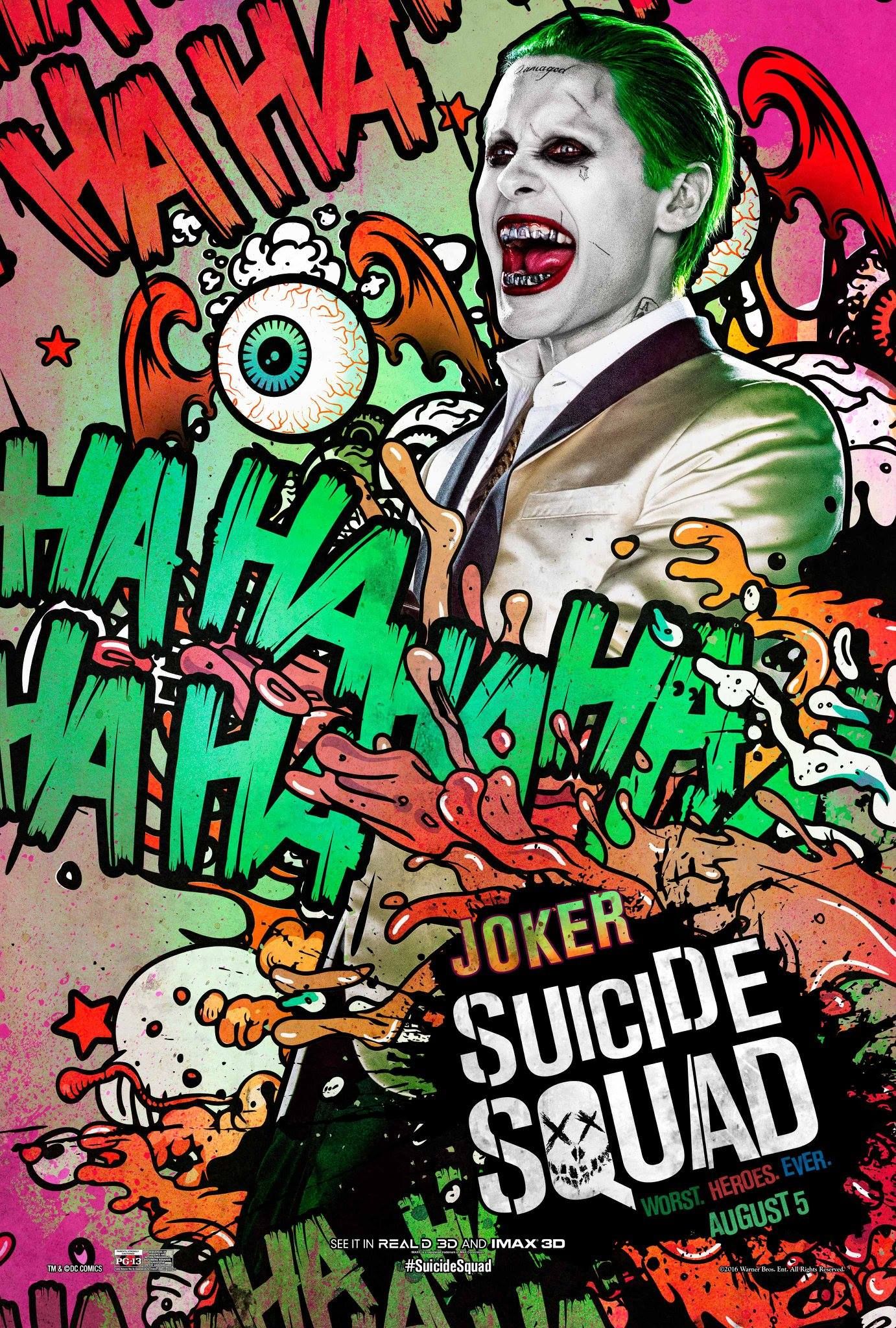
Jared Leto's Joker is barely seen in the film, despite the marketing.
Since the announcement that not only would The Joker feature in Suicide Squad in his first cinematic portrayal since the Academy Award winning turn the late Heath Ledger gave in The Dark Knight, but additionally that he would be portrayed by Jared Leto (also an Academy Award winner), there has been a lot expectations for the character, and rightfully so. The marketing for the film has relentlessly showcased the character in his own posters and trailers to the point where many fairly assumed he would be the main antagonist of the film. While some may consider this a spoiler, I feel it is necessary to know that the Joker not only isn't the main antagonist of the film, but he's in it for about six to ten minutes. This would be alright if he was marketed in the same way Batman was, where a quick shot in the trailer let's the audience know that he's in the film, but not much. However, the way Joker was marketed I could easily see a great number of fans being disappointed in how little he featured, because I know I was. The Joker really only fits within the context of Harley Quinn's flashbacks. He does make appearances in the modern day, but in a very brief subplot that disappears all too quickly and ultimately has no real impact on the film. And for those of you wondering "Well how is he in the film?", it's not an easy question to answer. The Joker is such a strange and intricate character that to judge somebody's performance on such minimal time is difficult, especially when the editing makes it obvious that parts of his scenes have been cut. If I have to judge it on what I'm given, I'd have to say Jared Leto is the weakest cinematic Joker to date. The direction of the character with his "gangster" update didn't really fit so well with the character, and Leto's performance rarely came close to bringing me over to the new style. His performance isn't so horrible that I'd object to seeing him in future instalments, but with such a high bar for the character being set by his predecessors it isn't really enough.

The mission and story of Suicide Squad is its greatest weakness.
The biggest problem with The Joker is that it offers you this more interesting character before quickly ripping him away, and when the mission that Waller sends the Suicide Squad on is not nearly interesting enough to make up for the loss. The plot becomes rather generic once the team get onto their mission, right down to the blue beam in the sky, and it feels like a gigantic waste of potential for such an interesting group of characters, especially when one of the greatest antagonists of all time briefly features only for the film to get back to its mind-numbing, boring quest. An additional problem with the mission that the Suicide Squad embarks on, and therefore with the main plot of the film, is that is doesn't work for what these characters are established for. Waller insinuates early in the film, and trailers, that the use of villains is because the government can easily throw them under the bus if something goes wrong. However the film fumbles with the idea of assembling a group of metahumans (DC Comics' term for powered individuals) in case a more powerful metahuman emerges. However, not only does this not suit the Squad's strengths, but it makes for a less interesting plot with these characters. The mission in the film feels grandiose in scale, and therefore more appropriate for a group such as the Justice League than the Suicide Squad. And when the film is set in an established universe where we know that these heroes exist including The Flash, Batman and Wonder Woman, it's extremely hard to wonder not only why the government didn't put any faith in them (there's not anything that they need plausible deniability for with this mission), but why they don't hear of the events and turn up to help anyway. The story would not only make more sense but also be more interesting if we followed a more contained story with questionable morals involved, allowing the plot to be as different from other comic book films as it's protagonists are. Instead we end up with a generic, cookie-cutter plot that wastes the potential of its characters.

Like BvS before it, the editing of Suicide Squad is a major flaw.
Suicide Squad also suffers on a technical aspect. I've mentioned the sloppy editing making it obvious that several Joker scenes had been edited, which Jared Leto himself confirmed, but this is a problem that plagues the entire film making the flow an absolute nightmare. This, along with the story, is one of the film's biggest problems and is a constant jarring issue that makes it difficult to become immersed. The effects, for the most part, are well done, but the third act uses them too much resulting in a needlessly CGI-heavy finale. There are some interesting filmmaking choices here and there, such as a certain scene of Enchantress transforming in a room which is filmed rather smartly, but they are too few and far between. The pacing of the film is also an issue; one that probably stems from the poor editing. A large chunk of the movie is dedicated to reeling off the characters one by one with flashy, stylised title-cards so the audience gets introduced to them, and rather quickly after that the Squad are sent on their mission pretty early into the film, meaning the mission itself ends up becoming tedious to watch and slow in points. Furthermore, the strange and uneven stylistic choices of the first act don't carry over for the rest of the film. Suicide Squad features more humour than the first two instalments in the DCEU, but all the best jokes are featured in the trailer. Equally disappointing, the action of the film is disjointed and rarely as spectacular as it could be. The score for the film is serviceable but nowhere near as memorable as the scores for Man of Steel or Batman v. Superman: Dawn of Justice before it. The soundtrack for the film is bombastic, borrowing from countless pop hits and using new tracks created specifically for the movie by modern artists. This is somewhat to the film's detriment though, as it constantly bombards you with song after song, not giving each one its own chance to breathe or become iconic, to the point where after you struggle to remember all the songs and what scenes they correlate to.

In conclusion, Suicide Squad is certainly an interesting and fresh take on the comic book film genre, but unfortunately wastes a lot of the film's high potential. The interesting rag tag Squad that differ from the stereotypical protagonists of superhero films are lumbered with one of the dullest and most generic plots from comic book film history. The script doesn't balance its large ensemble cast well with some of the interesting performances being lost in the chaos without getting a chance to shine, and even the larger stars of the film struggling to bring extra depth to their characters. The editing of the film is a nightmare, and one that makes you wonder whether or not integral scenes have been ripped out and Warner Bros. plan to release them with a Suicide Squad: Ultimate Edition, similar to what they did with Batman v. Superman: Dawn of Justice. Suicide Squad is some of the year's most wasted potential, and I hope we get a chance to see these interesting characters return in a better written and more well-balanced film in the future. For the time being, however, the DCEU remains controversially polarising.


Suicide Squad  -  4 / 10


Wednesday, 13 July 2016

'Ghostbusters' (2016) review


Ghostbusters is a 2016 comedy film directed by Paul Feig with the intention of rebooting the classic franchise that launched in 1984. I feel like with this review more than most, it's important to remember that Ghostbusters is indeed just a film, because with the absurd online disdain for this particular film you'd be forgiven for thinking it was ground zero for the battle of our culture. Many have slated the Ghostbusters reboot for months before its release for particularly poor trailers (which are among the most disliked videos on YouTube). The response to this hate hasn't been exactly calm either, with accusations of sexism being flung towards any who criticized Ghostbusters. It's a strange reaction for the world to have to a comedy film about catching ghosts, and despite the fact I felt the need to mention it here as the elephant in the room surrounding the film's release, let's put all of that out of our minds for now and focus on the product that has been delivered to us.

Ghostbusters follows three scientists who believe in paranormal entities and set out to prove their existence. Abby (Melissa McCarthy), Erin (Kristen Wiig) and Holtzmann (Kate McKinnon) soon form a team to investigate ghosts, teaming up with subway worker Patty (Leslie Jones) and dimwitted secretary Kevin (Chris Hemworth) to save New York from a ghoulish fate. The story is simple enough and quite similar to the one audiences will remember from the 1984 original, but with enough changes to argue that it's not a complete remake. The four Ghostbusters are all pretty good in their roles. As someone who isn't a fan of Melissa McCarthy's usual over the top shtick, I was glad to see that she toned it down considerably for this film. On the contrary, McCarthy and Wiig play the more straight roles in the films as compared to the eccentric nature of McKinnon and Jones' characters. Out of the four Ghostbusters, McKinnon was a highlight for me, with her character and performance sometimes bordering being too wacky, but usually entertaining enough to not worry. While I was glad to see that they weren't all competing with each other to "out-funny" one another and worked well as a unit, I would say that McCarthy and Wiig's characters don't bring a whole lot of jokes to the table which is a shame. In fact, the introduction to these characters is perhaps one of the weakest aspects of the film. Think back to the introduction of Bill Murray's Venkman in the original film where he performs a test on a young male and female and constantly pretends the woman has the correct answers so he can see her again. It introduced both his personality and the sense of humour you could expect from the character immediately. One of the first jokes in the reboot upon meeting two new characters is a fart joke, which immediately made me contemplate whether or not I was in for a really rough two hours. What's worse is that the joke followed a fantastic introduction to the film that absolutely nailed the tone and blend of scary and funny, only for that to seemingly be lost. Thankfully it's not something that lasts for the entire film is it often finds it's footing, such as their first outing as Ghostbusters and any time Chris Hemsworth is on screen being the film's shining moments.

The film never manages to stay consistent in quality throughout though. One element contributing to this is the strange editing. The pacing seemed thrown on numerous scenes that didn't really allow the jokes or actions to properly breathe, and sometimes would even cut from a shot of one character alone to a shot of her with other characters. With director Feig announcing an extended cut on Blu-ray, it's hard to not wonder whether or not the editing will be much better there just because the film has more breathing room. Outside of the editing, though, the film is still bizarrely put together. For every fantastic scene there's often a scene full of poorly executed exposition where the characters will narrate to themselves what they are thinking. There's even a moment where a character sees someone walking onto the tracks of a subway and mumbles something to themselves along the lines of "He's going on the tracks! He can't do that! I better stop him", as if the film believes the audience couldn't figure it out. This inconsistency hits with the film's jokes too. Sometimes the film would deliver what it felt like Feig believed to be a big hitting joke, and it would fall flat, only for a side joke by some secondary character later to have me nearly in tears laughing. The action sequences with the ghosts would often be great, with a scene involving Kate McKinnon being a highlight, but then some of the biggest action in the third act was among the worst. Indeed, inconsistency is one of the biggest problems that haunts Ghostbusters as it struggles to get full momentum going with the quality stumbling every so often, and isn't helped by occasional references to the original sometimes actually undermining the work Feig and his cast are doing to build a new story.

The action is also sometimes hindered by inconsistent CGI on the ghosts, with a lot of shots in the climax looking notably fake. But when the CGI works, I actually really enjoyed the designs of the ghosts here. The film uses stylized, neon appearances for them that really stand out, although I've seen some people complain that it makes the ghosts look too goofy, as if the most iconic foes of the original Ghostbusters weren't the bright green Slimer and gigantic marshmallow Stay Puft. Speaking of villains, the actual antagonists behind the attacks were rarely a strong suit of the franchise, and not much is different here as the villain is ultimately the same archetypal character we've seen in countless films before, including Sony's own The Amazing Spider-Man 2. The 3D for the film is rather interesting, as it uses the effect of the action bursting through the black bars at the top and bottom of the screen to give a more pop-out effect. It's a fun but cheesy concept that enhances the 3D and makes the film one of the best recent uses of the format. I also saw Ghostbusters in IMAX but I wouldn't call it a necessity at all unless you're close to one anyway, but if you do decide to go you can look forward to the sound being fantastic during the ghost scenes. This reboot is definitely a different take than the original, which personally for me is a good thing because it's bringing a fresh take to the concept rather than trying to imitate the first too much. However, I imagine the Ghostbusters banner could actually hurt this film a lot (as it already has with fans becoming insanely defensive), as it invites the audience to compare it to the original and I can imagine fans of the first will be saddened to find out that the bombastic tone of the film and the sense of humour is drastically different from the original, which played the events of the film extremely straight and dry.

In conclusion, Ghostbusters is an entertaining and interesting reboot of the franchise that manages to bring its own style to the concept. The film often hits its stride when allowed to be its own thing, but often stumbles with keeping the quality consistent, and the on-the-nose callbacks to the original only draw more attention to the film's setbacks. However, it's by no means a bad film or a bastardization of the brand, as there is entertainment to be found here, and if you have a couple of hours to kill at the cinema or when it inevitably hits Netflix, there's worse ways to spend it. At the same time, though, the film isn't great enough to fully smash through the pre-existing criticisms, and with a logo at the beginning of the film for a Sony owned "Ghost Corps" (a subsidiary of the studio relating exclusively to the Ghostbusters property it would seem), it doesn't exactly get me that excited at the prospect of the unstoppable wave of Ghostbusters films coming our way. Hopefully any future installments can learn from the setbacks of this one and build upon the successes to give us a film more worthy of the original.

Ghostbusters  -  6 / 10


Thursday, 2 June 2016

Superhero Television Ranked!


Superheroes are dominating popular culture right now. This year alone we're facing six major superhero film releases! This phenomena has leaked to the small screen too, with more and more superhero television shows showing up now. Whether it be ABC's tie ins to the Marvel Cinematic Universe, Netflix's grittier approach to famous Marvel characters, the CW universe of DC superheroes or others, it's hard to deny that this is the golden age for superhero television. But how do all of these shows actually compare to each other? To find out, I've compiled a ranking of most of the big superhero television shows airing right now. This list focuses on live actions shows, and only ones that have aired this past season. So while Agent Carter may have recently been cancelled, it just manages to squeeze into this list. Also worth noting, I have yet to watch the television show Powers, a PlayStation Network exclusive adaptation of the Brian Michael Bendis comic book, or Heroes Reborn, a miniseries revisiting the world created by the cancelled Heroes show. Therefore, neither obviously make the list. Finally, before we begin, an honourable mention to the DC show Constantine. It was a pretty good show with a great lead that was unfortunately cancelled a while ago (therefore ineligible for the list), but I figured it would be worth acknowledging due to the character currently surviving via a guest appearance on Arrow, and hopefully in future CW DC shows. Without further ado, here's the current superhero television shows ranked! 


9) Gotham


Gotham is a procedural cop drama set in the fictional city of beloved superhero Batman. The only catch is that Warner Bros and DC are very protective over their major characters like Batman and Superman, and others ready to debut in film (a problem that plagues a few other shows on this list), meaning that the show is set decades before Bruce Wayne dons the cowl. Instead, we follow Jim Gordon in his early days as a cop. There is actually some here within the show. The seedy crime element of Gotham could actually make for some interesting pre-Batman stories. Robin Lord Taylor shines as Oswald Cobblepot, the future Penguin, and is more often than not the highlight of the episodes he stars in. But the show is just an absolute mess. Rather than focusing down on a particularly engaging storyline, the first season drifts between wanting to be a procedural cop show and a superhero show, and it doesn't really get either right. It had some good qualities, but the bad outweighed the good by a considerable bit. The second season focuses down more with a goal in mind, and thus the show is doing slightly better because of it, but Gotham is more limping into a just above average show rather than striding into success. 

Best Feature: Robin Lord Taylor's conniving Oswald Cobblepot is the best part of the show, and his performance is always a joy to watch. 

Worst Feature: Penguin's rival in the first season of Gotham, Fish Mooney (Jada Plinkett Smith), wasn't a great character to begin with, but she stuck around longer than she had any right to and became an irritating beacon of the show's flaws.  


8) Agent Carter


Hayley Atwell's performance as Peggy Carter in Captain America: The First Avenger was undoubtedly one of my favourite things about that film. Unfortunately, regardless of the strength of the performance and the fanbase Atwell had behind her, Captain America needed to move on from her and be frozen in time until the modern day in order for him to unite with his comic book team in The Avengers. However, through the miracle of modern franchises, Peggy's adventures could continue on the small screen in the period piece drama Agent Carter. Unfortunately, for the most part, the show does not provide the content to suit the high bar set by Hayley Atwell's stellar performance. On paper, it sounds fantastic. Returning to the 1940's in the Marvel Cinematic Universe with a fan favourite character sounds like a fun and refreshing story. However, the show's narrative becomes somewhat of a hindrance, as the plots Agent Carter finds herself involved with are rarely that compelling. The first season is notably stronger than the second, which feels rather bland quickly. The potential for Agent Carter was extremely strong, but following disappointing ratings ABC confirmed that the show won't be returning for a third season. Still, the show is far from the worst superhero adaptation, and I would still recommend it to any Marvel buffs or fans of Hayley Atwell and her character from Captain America. There's plenty of fun to be had, especially when Dominic Cooper reprises his role as Howard Stark and introduces on of my favourite characters in the show: Edwin Jarvis (James D'Arcy), Stark's butler (presumably the inspiration for Tony's A.I. JARVIS witin the films) and a lovable addition to the MCU. It's an enjoyable enough show, but one that can't shake the feeling of wasted potential. 

Best Feature: Hayley Atwell is as fantastic as Agent Carter in the series as she was in Captain America, if not more so. The show is pretty much worth watching for her alone. 

Worst Feature: The narrative of the show isn't as compelling as I'd like it to be, especially given the 1940's setting and strong lead actress.


7) Legends of Tomorrow


Legends of Tomorrow is a fantastically fun concept. With CW's The Flash and Arrow introducing more and more interesting side characters each season, Legends of Tomorrow aims to collect them together in an ensemble time travelling show to give them their chance to shine. Legends capitalizes on the fun it can have with this concept as much as it can, with the varied team providing fun thrills each weak, despite the overarching story being rather weak. Indeed, looking at Legends from a purely critical perspective, it is incredibly easy to poke holes. Episode after episode, the continuity of the show is damned as the time travelling consequences rarely pay off. The season consists of a lot of filler episodes and the season long story provides little content for the payoff to be worth it. However, because of the fun that the show allows itself to have, the problems aren't as glaring as they could have been. On the contrary, the filler episodes are usually the better ones as the team engage in fun time-travelling scenarios without much regard for consequence. Unfortunately, the weak narrative throughout the season and poor continuity eventually weigh the show down, and by the season's end the show feels like missed potential. With the second season confirmed to be a shake up from the first, I have hope that Legends of Tomorrow can fully capitalize on it's concept with a more engaging narrative to match the fun it currently provides.

Best FeatureLegends' ensemble cast are extremely fun to watch, with only a few weak links in the characters dragging the team down.

Worst Feature: The season long story is rather bland and boring, and feels like it has been stretched too far when so many episodes resort to using filler content in order to keep the show going.


6) Supergirl


Like most TV, Supergirl has a rocky start with early episodes before it manages to hit its stride. However, unlike some of the other shows on this list, it takes longer for this stride to hit. Early episodes seem clunky as the show somewhat patronizingly tries to enforce the feminism of its main character almost apologetically. This isn't helped by constant comparisons to Supergirl's cousin, Superman, and how much better he is. Thankfully, the show eventually lets the actions of the characters speak for themselves rather than constantly telling the audience. Melissa Benoist really shines with her portrayal of Kara Zor-El, also known as Supergirl. The supporting cast are mostly strong, with David Harewood as Hank Henshaw and Calista Flockhart as Cat Grant providing particular depth to the show. The action ranges from middling to fantastic, with a mid-season bout with a Kryptonian feeling grand in scale. However, even after the show gets stronger, it still suffers from some glaring issues such as weak villains (both from a writing and acting perspective), an over-reliance on cliche love drama and a strange sense that something is missing, with constant references to Superman being made yet him only ever appearing as a silhouette due to restrictions from Warner Bros (who want Superman to remain in the films only, despite Supergirl being completely detached from Man of Steel). With the show moving to CW for its second season, I have strong hopes that Supergirl will only continue to grow in strength and move up the rankings.

Best Feature: Melissa Benoist's infectiously charming portrayal of Supergirl is really the series' strongest suit, which perhaps shines brightest when she shares the scene with a speedster superhero in a brief cameo episode.

Worst Feature: The first season of Supergirl lacks a compelling overarching narrative, instead relying on weak villains and predictable love dramas. Hopefully with the switch to CW, this will change for Season 2.


5) Arrow


In some ways, you could consider Arrow to be the spark that ignited the trend in superhero television we have now. With The Flash and Legends of Tomorrow spawning from it, it is definitely responsible for three of the nine shows on this list. It's debatable if it had any effect on the other shows, but the success of Arrow will have only given the rival shows confidence to go forward with their plans. With a solid opening season and a stellar second, Arrow was a strong example of how to do a superhero show, even if it strayed from the actual Green Arrow comic books frequently in favor of a grittier, almost Batman-like take. It's hard to complain too much though, when what we got was still excellent, with the show definitely peaking as Arrow took on the ruthless Deathstroke (Manu Bennett) in the action packed second season. So why so low on the list? Well, Arrow got a third and fourth season. And gradually the show slipped and stumbled from greatness into mediocrity. The writing became considerably weaker, perhaps even more noticeable due to superior sister show The Flash showing up at the same time as Arrow started slipping. Nevertheless, Arrow is still currently more bad than good, and the first two seasons at least are definitely wort a watch. Earlier seasons have strongly choreographed action sequences, an interesting performance from Stephen Amell as Oliver Queen, and some fantastic villains. Here's hoping the fifth season is a return to form before Arrow slips even further down the list. 

Best Feature: Arrow was at its strongest in its second season, and that's largely down to the brilliant rivalry between Amell's Oliver Queen and the deadly Deathstroke, played spectacularly by Manu Bennett. 

Worst Feature: About halfway through the third season, and continuing on into the fourth, Arrow feels less like the hardened, gritty vigilante show that it started as, and more of a teenage soap opera. Oliver Queen's central conflict comes more often from drama with his love-life and friends now than it does super villains.  


4) Agents of S.H.I.E.L.D.


Agents of S.H.I.E.L.D. is perhaps the definition of a rocky start. Over half of the first season is rather mediocre. The show feels more like a formulaic police drama than it does a flashy superhero spectacle, as the Agents go week by week and deal with a generic, cliche threat and then move on to the next thing. The show promised a crossover with Thor: The Dark World and delivered the agents cleaning up after Thor's climactic battle. But then Captain America: The Winter Soldier happened, and changed everything. In hindsight, the first season of Agents of S.H.I.E.L.D. seems like it was dragging its feet and waiting for Winter Soldier to happen so it could show everyone what it was about. The show smashed forward into action and became a much more enthralling show with every aspect of it benefiting from the change. The second and third seasons continue the strength that the later episodes of season one provided, thankfully, with the show managing to avoid the pitfall of the first season, and other shows with similarly large episode numbers, by dividing its seasons in two. One threat will be evident in the first half, with another taking over for the second. If you binge watched the show, it happens so naturally that you may not notice, but it really helps in keeping the show fresh. Clark Gregg's Agent Coulson is an obvious draw as one of the few elements familiar from the films, but his supporting cast are remarkably well developed, especially considering how generic they seemed to be in the earlier episodes. While early on it felt as though the show struggled to be compelling while not touching the major Marvel content reserved for the films, it feels grand in scope now within its own right, as the show tackles Hydra, Inhumans and more. The show develops fantastic narratives and a lot of heart as it goes on, and Agents of S.H.I.E.L.D. has grown into a fantastic companion piece to the Marvel Cinematic Universe.

Best Feature: The Captain America: The Winter Soldier tie-in episodes that pull the rug from under the audience's feet and reveals the show's true intentions.

Worst Feature: Too much of the first season is mediocre as the show plods along to the shocking reveal. You will be rewarded for your loyalty to the show if you can get past the first ten to fifteen episodes (with a good episode appearing every so often), but it won't be the easiest show to start.


3) Jessica Jones


Like SHIELD, Jessica Jones is connected to the Marvel Cinematic Universe. However, unlike SHIELD, Jessica Jones is a Netflix property and feels like a completely different animal to the likes of The Avengers. Focusing on a darker narrative than you could find in the films, Jessica Jones provides more gritty depth to the universe by focusing on the titular super powered private investigator having to re-encounter her old tormentor as he resurfaces. Said tormentor is played by David Tennant in perhaps the biggest draw to the series. His portrayal of the villain is so disturbingly charming that you'll often catch yourself off guard as to liking him, only to be reminded of the inexcusable actions he has previously committed. Krysten Ritter is an interesting lead as the volatile Jessica, with Mike Colter making a small standout appearance as Luke Cage. The show is almost as strong as Netflix's other Marvel property, but a few small issues stunt it from greatness, such as a drop in momentum towards the end of the series and annoyingly irrelevant sub-plots from uninteresting characters. Nevertheless, with Jessica due to return in the upcoming ensemble Netflix show The Defenders, Luke Cage set to get his own series and even a series of Jessica Jones confirmed, we're set to see a lot more from these characters. And while I'm uncertain on how the second season will fare as the show moves to a new story, I'm excited to find out.

Best Feature: A fantastic performance from David Tennant as Kilgrave, Jessica Jones' nemesis. Tied in with the dark nature of the character and some terrific writing, he's one of the best antagonists you're going to find in the Marvel Cinematic Universe.

Worst Feature: Some of the side characters and their subplots within the show fail to be as strong and entertaining as characters such as Jessica, Luke and Kilgrave, meaning whenever they appear the show's momentum grinds to a halt.


2) Daredevil


Before Jessica Jones, Netflix released Daredevil, and blew everyone away. The series washed away the bad taste that the 2003 movie had left in the general public's mouth, and gave us one of the best superhero adaptations of all time. Charlie Cox instantly falls into the role of Matt Murdock, also known as Daredevil, and pulls off playing the two alternate sides to his character extremely well. The entire cast is strong, but the other two members I will particularly call out is Vincent D'Onofrio's Wilson Fisk, the villainous Kingpin of crime that Matt must oppose in season one, and Jon Berthnal's Punisher, who opposes Daredevil in Season two. The action for Daredevil is brutally choreographed, and rivals much of what you'd find even in Hollywood. The story in Season One is absolutely remarkable, and in my opinion I thought it never faltered or lost momentum as it headed towards the conclusion. However, the Second Season arguably had a major drop. The season felt fragmented into two separate stories; one spearheaded by the conflict with the Punisher and the other focusing on characters such as Elektra and Stick from Matt's past. The season stumbled a lot as it continued and as the main narrative failed to live up to the example set by the first season, but it was still extremely enjoyable in its own right. However, the shortcomings of the second season drag Daredevil down from what I would have ranked it had it just been the first. Like Jessica Jones, Daredevil is set to reappear in The Defenders. Unlike Jones, Daredevil is yet to be secured for a third season. I take this as good news personally. As Netflix begins firing on all cylinders with Luke Cage, Iron Fist, The Defenders and now a Punisher spin-off show, it is perhaps for the best that they slow down a bit and take their time again with Daredevil to ensure that the following seasons are more in line with the original. Check out a full review of the first season here!

Best Feature: Vincent D'Onofrio as Wilson Fisk is absolutely incredible casting, and he crushes the role. Giving some depth to the Kingpin of Crime, it's hard to think of many villains in superhero adaptations that actually stand up to this guy.

Worst Feature: The second half of the second season has a weaker narrative than the rest of the show, with the Punisher's story becoming over-convoluted and the Hand story being rather messy. Still, even when stumbling, Daredevil is better than most.


1) The Flash


Deciding between The Flash and Daredevil for the top spot was an extremely tough call to make. Both have masterfully done first seasons and slightly disappointing second seasons. Looking purely at the first seasons, I would have to give Daredevil the ever so slight edge. However, factoring in the second seasons, The Flash just manages to speed ahead, as even when the show isn't totally on form, it's such an entertaining time. The Flash focuses on Grant Gustin as Barry Allen, a forensic scientist who suffered the death of his mother at the hands of a supernatural element as a child. His father is wrongly imprisoned for the crime, and when Barry gains superhuman abilities, he vows to protect the city and find justice for his father. The writers of the show confess that they have three words above the door to their writers room: Heart, Humour and Spectacle. The show delivers in spades on all three. The tragedy Barry endured as a child doesn't mean the show is weighed down with his sorrows. On the contrary, the bright and cheery show of The Flash feels like the antithesis of the gritty tone sister show Arrow started out with. But the show does pack a lot of emotion as Barry deals with his new powers and his parental issues. The villains can be hit and miss but much like in the comics Barry has a strong core rogues gallery to face off against, including the ludicrously named yet fun Captain Cold (Wentworth Miller), Weather Wizard (Liam McIntyre), Heatwave (Dominic Purcell) and the brilliant Mark Hamill returning in his role as The Trickster from the 1990's Flash show. There's even fully CGI villains every so often with better effects than you'd expect from a television show, particularly one situated on the CW. The Flash's true nemesis from the comic books is a strong here, as Reverse-Flash plagues Barry Allen for the first season in a fantastic story arc. While not as strong as his predecessor, Zoom continues to be a terrifying threat to Flash as the antagonist in the second season. When The Flash hits its stride, it does so magnificently, delivering some of the best superhero content you can get out there right now. Even when it stumbles, such as several spots in the second season or a couple of early "villain of the week" styled episodes in the first season, The Flash is strong enough in its core respects to still be entertaining. Set to return for a third season this Autumn, here's hoping that The Flash can continue to be the strongest superhero television show there is, and that it continues to deliver on heart, humour and spectacle. For a full review of Season One, click here!

Best Feature: While it's tempting to give this honour to the fun spectacle and effects that the show provides with its countless superhero showdowns, it is undeniable that the absolute core of the show is its heart, and that is best on display with Barry's relationships with his friends, fathers (both foster and biological) and even with his foes. 

Worst Feature: In the wake of a fantastic closing half to the first season, the second season does stumble a few times in trying to live up to expectations, most notably in failing to create an overarching season long narrative that is quite as interesting as what came before. 


Wednesday, 1 June 2016

'Teenage Mutant Ninja Turtles: Out of the Shadows' review


Teenage Mutant Ninja Turtles: Out of the Shadows is the sequel to the 2014 reboot of the classic 1980's franchise. Sporting a new director with Dave Green (Earth to Echo) replacing Jonathan Liebesman (Teenage Mutant Ninja Turtles, Wrath of the Titans) and featuring a marketing campaign showcasing its fan-pleasing array of characters, Out of the Shadows is set to take aim at fans disappointed with the 2014 predecessor and bring them on board with the newly relaunched franchise. The film follows the four brothers and ally April O'Neil (Megan Fox) on the trail of a sinister plot relating to their nemesis, Shredder (Brian Tee). As they discover more, the turtles must join forces with Casey Jones (Stephen Amell) to ensure the safety of New York .

Fans of the classic Teenage Mutant Ninja Turtles franchise may find the new film has a lot to offer them, as the film is littered with new fan-favourite characters. The villainous Shredder is now joined by his henchmen Bebop (Gary Anthony Williams) and Rocksteady (WWE's Sheamus), a mutated warthog and rhino set to give the turtles a physical match. Stephen Amell joins the cast as vigilante Casey Jones with a slightly different background to the one fans will be familiar with. Shredder is quickly revealed to be in leagues with Krang (voiced by Brad Garrett), a being from a different dimension who plans on enslaving our own. Tyler Perry stars as the nefarious scientist, Baxter Stockman. With so many new characters joining the already large cast, you'd be forgiven for worrying that the film could easily collapse under its own weight. This surprisingly doesn't become an issue, as the numerous villains all serve one narrative thread, unlike for example Spider-Man 3 or The Amazing Spider-Man 2, both of which utilized three separate villains with their own narrative that made those films clunky and overstuffed. The one issue it does present, though, is that fans may be disappointed to discover their favourite characters don't get a lot to do. Casey Jones does indeed don his iconic mask, but it's for one sequence that fans will have already seen in the trailers. Krang is technically the main villain, but the film doesn't spend a lot of time with him. The character isn't really set up, either, making his initial appearance early in the film rather jarring. Shredder (he main antagonist from the previous film) returns here with a stronger character, but that's mainly due to the film actually giving the character a strong actor, whereas in the first film when unmasked he was played by an unknown in the shadows. However, this goes to waste as Shredder's role in the film is incredibly minimal. The two characters that really get a chance to shine are Bebop and Rocksteady, as the film utilizes them as the physical lackeys, or "errand boys" as Shredder puts it, to the main villains, allowing them to be the physical presence against which the turtles battle for the majority of the film. The two are stupidly charming, and arguably a highlight of the sequel. 

The first Ninja Turtles film succeeded whenever it allowed the fun of the franchise to leak through and the four titular turtles' personalities shined through the Michael Bay remake filter that some believed plagued the first, with many citing the elevator scene as a highlight of what the film should have focused on. While Bay's grubby thumbprints can still be seen on the sequel, with a scene of Megan Fox using her sexuality to fool a villain feeling in line with his Transformers films, Out of the Shadows gives a lot more focus to the turtles, making for a funner film than the first. Not all of the humour sticks, but enough does to make the film enjoyable. Out of the Shadows also attempts to explore the characters a little deeper than the first, but stumbles as it does. While all four brothers struggle with balancing their obsession for the culture of New York and the people that live their with their inability to blend among us, it is a particular struggle that the character of Michaelangelo struggles with. Mikey is given a strong scene in the film relating to this which is actually touching, but the film doesn't spend any time after it developing it. Rather, the character arcs of the turtles quickly falls into rehashing the problems they faced in the first film which are suddenly solved at a point where they are needed to be rather than coming to a natural conclusion. I feel that with some extra time spent on the script, there is actually a solid story to be told here focusing on the turtles, but in the current revision it gets lost as the action ramps up in the second half of the film. The action was perhaps the strongest advantage that the first film had, but here its somewhat weaker as battles between characters are considerably shorter and there aren't any sequences as memorable as you'd like them to be. The visual effects aren't going to win any awards, but given that the film serves as a live action Saturday morning cartoon they do their job just fine. Steve Jablonsky replaces Brian Tyler as composer, and while the new score isn't quite as good as the last, he at least leaves a treat in the credits for fans of the cartoon. The story of Out of the Shadows isn't really anything special. Shredder, Krang and their villainous company wish to do villainous things for villainous reasons, and the heroic turtles must stop them. But the story is really just there to serve as a catalyst for the main characters, and while you could definitely argue that a stronger story could make a stronger film, it's hard to be too hung up about it when you look at the product as a whole.

In conclusion, Teenage Mutant Ninja Turtles: Out of the Shadows doesn't really bring much special to the table. A number of characters in the film's impressive roster are unfortunately underdeveloped, the action feels like a step down from the previous installment and the story isn't that great. But where the film succeeds is with the heart and personality of the four core characters and the fun the audience can have with them. The film spends more time with them than its predecessor, and Leo, Donnie, Raph and Mikey are all given discernible and fun personalities that make the film enjoyable enough, which is helped by the fun the film has with the henchmen they oppose, Bebop and Rocksteady. There's enough heart and humour in here to make it a fun ride, even if a lot of other aspects of the film remain largely unpolished.

Teenage Mutant Ninja Turtles: Out of the Shadows  -  6 / 10

Monday, 23 May 2016

'X-Men: Apocalypse' review


X-Men: Apocalypse is the latest in a series of films based upon the immensely popular Marvel Comics series. Apocalypse serves as the third in a prequel trilogy, following First Class and Days of Future Past, but is ultimately the ninth cinematic X-Men outing after its predecessors, an original trilogy, two Wolverine spin-offs and a Deadpool spin-off. X-Men: Apocalypse follows Charles Xavier (James McAvoy) and Erik Lehnsherr, also known as Magneto (Michael Fassbender) in 1983 as they encounter a new and dangerous mutant opponent in the form of En Sabah Nur, known better as Apocalypse (Oscar Isaac). As Apocalypse's forces grow, Xavier's new students, including the young Scott Summers / Cyclops (Tye Sheridan) and Jean Grey (Sophie Turner), must battle to save the world. As a far warning, while this review will be spoiler-free for Apocalypse, there will be some spoilers for both First Class and Days of Future Past

This new X-Men trilogy has embraced a fascinating idea from the beginning. Following the 1960's setting of First Class, each film in the trilogy has focused on the subsequent decades. Days of Future Past was based within the 1970's and now Apocalypse finds itself rooted within the 1980's. It's an interesting and fresh gimmick which gives this trilogy a unique aesthetic, and allows us to look upon the most important moments in the fictional mutant world, almost as though flicking through a history book. However, this is an element which Apocalypse struggles to manage. 21 years has passed in Apocalypse since we first saw Xavier, Magneto, Mystique (Jennifer Lawrence) and Beast (Nicholas Hoult) in First Class, yet none of them look as though decades have passed. An offhand comment is made that a returning character doesn't appear as though she has aged a day as the film shows it's aware of the problem the trilogy has made for itself, but it doesn't help how jarring it can be when the characters refer to events from previous film as though decades have passed, despite their being little sign of aging with anybody. Another issue is that by jumping significant portions of time between story, it can be a little jarring to see where characters have ended up, This worked to the benefit of Days of Future Past as we learned more about why Xavier and Magneto had ended up where they were at the start of the film, but in Apocalypse there were a few situations where I struggled to think of a coherent way for a character to have evolved from where they were at the finale of the previous movie to where they were now, and it would have been interesting to see the film develop this more. 

Speaking of characters, this has usually been a strong suit of the X-Men franchise as everything is usually heavily character driven, with the superhero spectacle being the icing on top. However, Apocalypse falters in this regard a fair few times. Returning characters such as Magneto have significantly weaker arcs this time around as compared to their previous appearances. Some character arcs feel like they're retreading ground the characters have already covered that, within the context of the narrative, would have been resolved decades ago. Several new characters suffer immensely from being two-dimensional and simply being on screen for the sake of giving the X-Men opponents to battle against. Upon his arrival, Apocalypse quickly gathers four followers to aid him. While one is a major character with significant development, the other three feel as though they're just there for the convenience of the story. None are really poorly acted, but it's more an issue that the actors aren't given enough material to prove themselves. Apocalypse's own character is rather underdeveloped. The film provides a baseline motivation for him so we can understand why he's doing what he does, but it's not an interesting one. His character is hindered even more by the fact his plan feels paper thin and as though he's making it up as the film rattles along. Isaac feels wasted in the role as Apocalypse falls into the pit of underdeveloped comic book movie villains. The X-Men all have strong characters, with Nightcrawler (Kodi Smit-McPhee) being a personal highlight along with Sheridan and Turner's portrayal of classic characters Cyclops and Jean Grey being surprisingly captivating. Mystique's character was perhaps one of the rockiest of the film. Her development sometimes felt natural from the events of the previous films, but other times it felt like it was contradicting elements of her character just to capitalize on Jennifer Lawrence's star power. Perhaps the strongest performance here is unsurprisingly from Fassbender as Magneto. His performance often felt like it was surpassing the material he was given, with corny scenes given an emotional boost by him.

The story of X-Men: Apocalypse is perhaps one of the weakest in the entire franchise. Perhaps this is due in large part to the failures of Apocalypse as a villain, as I feel given a stronger antagonist, the narrative would have felt more coherent and driven by his character. With two and a half hours for a running time, there isn't much excuse the film can give for not developing its villain, especially when a significant portion of the film features characters going to a new setting on a detour that provided nothing for either their characters or the narrative other than allowing a cameo to be shoehorned into the film. This is all precious time the film could have devoted to allowing us to understand Apocalypse more and therefore letting the narrative be driven more by his plans. The other problem is that Apocalypse doesn't manage to cover a lot of new ground that we haven't already seen. As it stands, X-Men: Apocalypse is a series of disjointed scenes held together loosely by a series of jarring conveniences (such as a character just happening to appear in time to everyone's rescue, or another character's unconvincing change of heart at just the right moment) as the film drives full force into its gigantic climactic action setpiece between the X-Men and Apocalypse. The final fight is somewhat of a let down, too. Sure, the spectacle is there. But gone is the character driven climax from the previous two installments and the creative use and demonstration of the abilities, as here they are replaced with a heavily CGI reliant sequence in which characters slog it out until one side emerges victorious in an exhausting resolution. It's far from the triumphs of First Class and Days of Future Past, but makes more a satisfactory enough mindless action film. Given the strengths of the franchise, though, it's nowhere near enough to make Apocalypse a must see, especially when there are at least six stronger entries in the franchise. 

In conclusion, there's enough spectacle in X-Men: Apocalypse to make it a satisfactory film for hardcore fans of the franchise, and some strong performances may help more casual fans enjoy it more. However, with both the earlier films in the trilogy being considerably stronger films, plus the first two films in the original trilogy, and additional spin-offs in The Wolverine and Deadpool all being more entertaining, smart and enthralling, there feels like little reason for anybody else to check out X-Men: Apocalypse. It plays a lot like the Greatest Hits montage of the franchise, but one that consists entirely of weak covers by lackluster bands instead of the original classics. There's a scene in the film where a character states that the third film in trilogies is usually the worst. It feels like a sly dig from Bryan Singer at the third film in the original trilogy, X-Men: The Last Stand, which was the only one he didn't direct and was considerably worse than the first two. However, the joke blows up in Singer's face when Apocalypse also turns out to be a massively disappointing third entry in an otherwise fantastic trilogy. 

X-Men: Apocalypse  -  5 / 10

Sunday, 15 May 2016

'Uncharted 4: A Thief's End' review


Uncharted 4: A Thief's End is the fourth and final installment in Naughty Dog's PlayStation exclusive Uncharted series. Following the events of the first three games, protagonist Nathan Drake has settled down from treasure hunting to enjoy a normal life with his wife, Elena. However, when his brother Sam resurfaces with the promise of one final adventure, Nate is dragged back into his old ways. Uncharted 4 is the first of the series to debut on PlayStation 4, and as such the series' finale has received a fitting upgrade in terms of scale as Naughty Dog are able to cut loose and push Uncharted to places it has never been. Can A Thief's End meet the high expectations fans have after the previous three fantastic installments?

The answer is quite simply a resounding yes. Naughty Dog are no strangers to delivering some of the best games on the market, with their Crash Bandicoot and Jak and Daxter games considered classic gems by many, and more recently the Uncharted series and the absolutely masterful The Last of Us showing they're still willing to push their limits. Uncharted 4 shows that Naughty Dog are still constantly evolving as it is undoubtedly one of the best looking games you'll be able to find on the market. From the amazingly detailed and convincing character models to the lush environments you visit, Uncharted 4 rarely misses an opportunity to stun you with the graphical capabilities of the game. The hyper-real character models lends a window into Naughty Dog's true trump card too, as the emotions of the characters pour through the detailing in their faces, allowing the player to engage with the characters on an emotional level that ND proved they were capable of providing masterfully through games in The Last of Us

The characters of Uncharted have always been one of the series' true triumphs. While the graphics are always outstanding and the gameplay is always a blast, what keeps the games close to the players heart are the characters and their personal stories. Drake returns with Sully and Elena and the bond between them has long been one of the highlights of the franchise, and it's on full form here as their story comes to an end. Among the action and gunfights, Uncharted 4 has emotional scenes that help you engage in the game on a level deeper than the superficial spectacle that makes your actions feel like they have true weight. Beyond that, the story of the game is equally as engaging. The Uncharted franchise has always incorporated isolated stories, with the character arcs carrying through each installment. The same is true with A Thief's End, as the main plot is one newcomers can thoroughly enjoy without having to worry about three games worth of narrative to understand. However, as previously stated the character arcs do carry on throughout all four games, and any new players will probably benefit from playing the original three, or the remastered Uncharted: The Nathan Drake Collection, if they want the character beats to pack a weightier punch. 

As with the previous entries, Uncharted 4 follows Nate as he uncovers a legendary treasure, and as more details come to light about the treasure it becomes apparent that the truth behind it is much more sinister. The game allows opportunities for the player to dig deeper into the mystery behind the treasure as optional notes can be found hinting towards a larger conspiracy, and it shows the developers embracing the video game format once again after Last of Us and telling a deep and interactive story in a way mediums can't. The story of the treasure is indeed an intriguing one, and one that fits well thematically with the issues the characters deal with throughout the game. There is a strange moment within the resolution where the actions of one character doesn't fit within the theme of the game, but it's a minor bump on an other wise extremely smooth journey. Another minor issue I had with the game was the handling of the antagonist. There is definitely enough interesting motivation behind the villain to make him the franchise's best, but the game doesn't highlight them until late in the third act, and even then they are mostly told in passing and not fully explored within the context of the narrative. It feels like a missed opportunity to give Drake and his final rival a truly interesting relationship and explore it more, but thankfully it's not an issue that hinders the enjoyment of Uncharted 4 too much. 

Fantastic characters and stories would be wasted if the game as a drag to play. Luckily, Uncharted 4 features the most refined gameplay of the franchise. Because of the attention to detail that Naughty Dog pour into each location, exploring the environment ends up being funner than previous entries, especially as the locations in game are considerably larger than previous games. The fights with in the game have a raw feeling to them, helped by the spectacular graphics and sound design of the game. Things feel truly desperate as you continue to find yourself outnumbered in fights as bullets whiz through the air and bludgeon the cover you hide behind for safety. Action receives a shakeup with Nate's grappling hook, which allows you to swing through the scenery and get the advantage on your enemy. The action in Uncharted 4 frequently feels ripped straight from a blockbuster, with the franchise's staple setpieces returning to great effect, although this game feels like it was missing a definitive action beat such as the train crash in Uncharted 2: Among Thieves or the plane crash in Uncharted 3: Drake's Deception

Fans can rest assured that there's more to the game than the spectacular fifteen hour campaign, as the game comes with a Multiplayer mode. I haven't poured in enough time to give a detailed insight into the multiplayer, but from the few matches I have played the game manages to provide a fresh feeling to multiplayer shooters as Uncharted's gameplay mechanics fit better with the online format than you would expect. In conclusion, Uncharted 4: A Thief's End is another masterpiece from Naughty Dog. Thrilling stories, layered characters, stunning graphics, incredible sound design including a cinematic score and compelling voice acting, enthralling gameplay and more. Uncharted 4 is truly another triumph, and a fantastic send-off, for Naughty Dog's thrilling blockbuster franchise. Like The Last of Us before it on PlayStation 3 (and remastered on PS4), if you own a PlayStation 4 and don't try Uncharted 4, you're doing yourself a disservice. It's games like Uncharted 4 that convince even gamers who don't have a PlayStation 4 to buy it, forcing them to buy a new console in the process. With Nathan Drake's adventures receiving a fitting conclusion, I can't wait to see what Naughty Dog have up their sleeves next. 

Uncharted 4: A Thief's End  -  10 / 10